Guest Post by Cynthia Ravinski: Visuals, Imagery, and Crafting Story from Dream

Today we have a guest post from EmotoBook author Cynthia Ravinski. I think the EmotoBook concept is extremely cool because it capitalizes on the strengths of the ebook form. All too often ebooks are seen as a replacement for paper books. And, of course, they are that — but only in part. They’re also a new medium in their own right, and what Cynthia is doing with her books takes advantage of that new medium’s strengths. So, without further ado, here’s Cynthia:
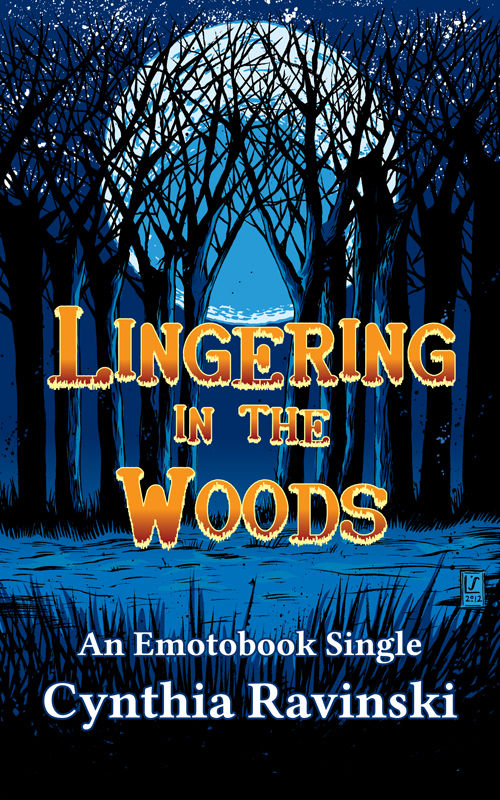
I’m a part of the EmotoBook Revolution. Let me tell you how that happened (I’m a story teller, that’s what I do). Writing an EmotoBook changed the way I look at writing. So let’s start there.

For me, a story starts with a dream — vivid color and poignant action streaking across the movie screen of my resting mind with abstract gravitas. I think the strangest thing is that there are never any words.

If I decide an Idea is worth turning into a story, it’s usually because it has haunted me for days and I’m thoroughly mad like the Hatter about the thing. And then, I only face the task of crafting it into something intelligible to other humans. Let me step aside here to say that without an Idea no writing can be done, there is only that familiar blank, white screen with a blinking black cursor. With an Idea, I at least have something to hang some words on, from which I will shape my story.

Crafting a story is a very technical thing, and is separate from the story Idea. Simply relating events is not truly Telling a story, it misses a lot of resonance. A writer’s job is to craft a story so that black and white text creates an internal cinematic dreamscape for a reader. There are many tools a writer uses to do this. One of the most important, I think, is visual imagery. When readers look at text, all they see are black lines on white. I’ve always been completely seduced by a brief chain of words that can slip a ravishing scene into my head.

sample EmotoBook page

The idea of EmotoBooks as a literary form lodged in my mind and haunted me for days after I’d first heard of it. Using abstract imagery to enhance the reading experience tackles multiple areas of the brain, and appeals to my vivid dreamscapes that have no words. Louis Sullivan, an American architect, put it perfectly, “form ever follows function.” EmotoBooks have a unique style and structure. They are all fast-paced, imagery-heavy short stories or serial novels containing abstract, emotionally provocative illustrations to depict what characters feel during peak moments of tension. These expressionistic elements provide both a cerebral and visual stimulation, which enhances the experience.

When I began the editing process for my EmotoSingle, Lingering in the Woods, it was glaringly obvious that my instinctive use of imagery was not as effective as I would have hoped. I’ve always tried to keep my stories visually balanced, like in my dreams, but it became apparent that in doing so, I reduced the impact of important scenes. Encouraged by my editor at Grit City, I intensified the imagery in the most powerful parts of the story as a seat for the abstract artwork going into the story. Through this craft element, I added a texture to the story I wouldn’t have found before, visually highlighting the peaks and valleys of the plot.

Writing stories is a grand puzzle with no absolute solution. Trial and error is the best way through that maze. I only hope that my work’s images burn lively in the minds of readers.

Cynthia Ravinski writes EmotoBooks, among other things. From her coastal northern setting she works language into stories. She’s been an athlete, a co-pilot, and a world traveler. She’s basked in the light of great poets, and has been educated to high degrees at UMaine Farmington and Seton Hill University. To say she is obsessed with drinking tea is an understatement. You can find Cynthia  at her blog, on Facebook, and on Twitter (@CynthiaRavinski).

MM: Understanding Apposition

Sorry for the long absence! I’m finally reasonably settled back into my “day job,” new house, and so forth. It’s about time to dig back into my shadowy secret life of fiction-writing, reviewing, and blogging. I figured I’d kick things off with a post about commas. I mean, really, you can never talk too much about commas, right? So here we go: apposition.

Apposition is the placement of two grammatical elements (words, phrases) side by side in a mutually defining or modifying relationship. Here’s an example:

My father, Frederick Brown, recently moved to Portland and bought a house next door to my sister Alice Smith.

In the above sentence, “my father” is in apposition to “Frederick Brown,” and “my sister” is in apposition to “Alice Smith.”

The $64,000 question is why “Frederick Brown” has commas around it but “Alice Smith” doesn’t. The reason? “Frederick Brown” is a non-restrictive or non-essential appositive — since the speaker only has one father, “my father” and “Frederick Brown” are synonymous. “Frederick Brown” doesn’t restrict the category of “my father,” so it’s non-essential. Non-essential or non-restrictive (these terms are interchangeable) appositives need commas before and after.

In contrast, “my sister” and “Alice Smith” might or might not be synonymous. Why? Because the speaker could have more than one sister. By not putting commas around “Alice Smith,” the speaker is as good as telling you that she has other sisters besides Alice. “Alice Smith” is a restrictive or essential appositive because the category of “my sister” needs to be restricted: which of the speaker’s sisters now has her father as a neighbor? Alice (rather than Susan or Tanya).

Errors in choosing whether or not to comma around appositives are quite common. My students often produce sentences like this one:

Shakespeare’s play, King Lear, is bleakly nihilistic.

Why is that wrong? Because Shakespeare wrote many plays, so “Shakespeare’s play” and “King Lear” are not synonymous. “King Lear” is an essential appositive because the category of “Shakespeare’s play” needs to be restricted. Therefore “King Lear” should not have commas around it.

Now if you said, “Shakespeare’s final romance, The Tempest, is less preoccupied with loss than his earlier forays into that genre,” you’d be fine. Why? Because Shakespeare could only have written one of his romances last. That category can, by definition, only include one play, so “The Tempest” and “Shakespeare’s final romance” are synonymous. “The Tempest” is a non-restrictive or non-essential appositive and therefore needs commas.

Incidentally, the same restrictive/non-restrictive rules apply to commas around clauses:

You should never ride motorcycles, which are dangerous.

You should never ride motorcycles that are dangerous.

In the first sentence above, “which are dangerous” is non-restrictive: the speaker is labeling all motorcycles dangerous and to be avoided. But in the second sentence, “that are dangerous” is restrictive: the speaker is telling you that only a subset of motorcycles (the dangerous ones) should be avoided. It’s nice when writers use “that” to begin restrictive clauses and “which” to begin non-restrictive ones; it makes the distinction more evident. But the which-vs.-that rule isn’t universal, and you will see “which” being used in both cases. That means the comma is the sole true indicator of restrictiveness vs. non-restrictiveness.

Shane Jones, Borders, and Book Culture

Novelist Shane Jones has an article about Borders in Salon (thanks to The Passive Voice for the link). It’s about how much he liked Borders as a book-centric hangout and workplace, how he met and fell in love with his wife there, and how the company floundered as sales began falling in the mid-aughts. Jones sadly wonders, at the end, whether bookstores will still exist when his unborn child comes of age.

You know, I don’t think they will. With a few exceptions for used books, kids’ books, and niche markets, I don’t see how dedicated brick-and-mortar bookstores can compete. I can foresee a time in the not too distant future when paper books are sold 1) online, perhaps increasingly through POD, or 2) in mass quantities at supermarkets and Walmarts, if they happen to be mega-sellers.

And yeah, that does make me a bit sad. I worked at a Borders in 1999. It was a great experience. I was never one of those folks who hated the big-box bookstores for driving the little guys out of business. To me, being able to walk into a huge bookstore and be pretty darn sure I was going to walk out with just the book I wanted was heaven on earth. Borders epitomized that. Not only did it have a ton of literary fiction, but it also had a deep selection of theory and philosophy — one of the sections I shelved — and a whole lot of poetry. Not many people bought those books, but they were there anyway. It felt like Borders was standing up for them.

I remember this one time when a middle-aged guy came storming up to the customer service counter and demanded to see a manager. The manager arrived, and the guy started yelling at him about the sexy gay book his (clearly unsupervised) little boy had picked up in the erotica section. I remember the guy, all red in the face, waving the book around and shouting, “You call yourselves a family bookstore, and you stock this filth?!” And the manager, cool as a cucumber, said, “Borders isn’t a ‘family’ bookstore. We serve the whole community. The whole community.” It was awesome. The people who worked there were terrific. That was a good place.

In the end, Borders died by its own sword: it beat the little guys by making exactly the book you wanted available immediately for a low price while providing hundreds of other titles to browse … and you could do it while drinking a latte. Then Amazon came along and did the same thing better … and you could do it without leaving home.

Yeah, it does make me sad. But let’s not forget that the rich book culture Jones talks about in his piece hasn’t disappeared. It’s moved. It’s on Goodreads and Facebook and the Amazon forums and authors’ websites and countless other places. Book-lovers will always find “places” to congregate. They’ll always build networks.

Is it the same? No, not really. But in some ways it’s better. A bookstore could never provide what I’ve found on Goodreads — a worldwide community of urban-fantasy readers. And of course, Borders never would’ve stocked my book. That book culture was far less open and inclusive than the one we have now.

That’s not to say the end of the bookstore doesn’t entail real losses — just that how the gains and losses balance out probably depends on who you are and what you’re looking for.

Stephanie Laurens and the Next Generation of Publishing

Stephanie Laurens’s terrific keynote address from this year’s Romance Writers of America conference is really worth reading. I won’t say it contains earthshaking revelations, but it does lay out the current state of publishing and its prevailing trends in a very clear way — including some great graphics. In so doing, it makes reassuring points about the new centrality of the author.

Laurens does seem somewhat of two minds on the future of the traditional publishing industry — what she calls “offline publishing.” On the one hand, she emphasizes the herculean task that lies ahead of such publishers as they try to adapt:

offline publishers are, unsurprisingly, seeking to transition into the online industry. To successfully transition, a previously offline publisher needs to accomplish two feats — first, refashion their old business into an author-oriented publishing services business, and second, convince authors of their worth in what is emerging as a fiercely competitive field. Those two feats form the challenge that lies squarely before offline publishers wishing to transition into the online sphere.

Two aspects of that challenge deserve special mention. First, remember how things were in the offline industry — author sells her work to publisher. In the online industry, publisher sells its services to author. That is a 180-degree turn around in relationship.

I know many authors are having difficulty getting their heads around that, and unsurprisingly offline publishers are having an even harder time grappling with the change, but to claim a position in the online industry, offline publishers must embrace and internalize this attitudinal switch. (accessed 7/27/12, my emphasis)

Pretty tough tasks, eh? Especially the one I’ve highlighted, which demands alteration of the entire publishing business model. Ouch. How many of you got to “refashion their old business into an author-oriented publishing services business” and thought, Hot damn, is that all?!?

On the other hand, Laurens closes with the idea that authors of the future will have a variety of distribution choices:

author –> readers;

author –> retailers –> readers;

author –> publisher –> readers;

author –> publisher –> retailers –> readers.

See the word “publisher” cropping up a couple times in those options? The speech has just done an awfully good job of explaining the wrenching changes publishers will have to make to stay relevant … and yet they’ll remain a viable distribution option?

Well, maybe. Or maybe the publishers Laurens envisions participating in these future distribution chains are not the same entities that lay claim to the “publisher” title right now, and she’s just too nice and tactful to say so. Perhaps the publishers of tomorrow will be the patricide offspring of today’s struggling industry — companies that don’t have to change themselves because they’re brand new.

Mark Coker, Agency Pricing, and The Indie Surge

Check out Smashwords founder Mark Coker’s blog post on the big sales/profit advantage indie authors now enjoy (thanks to The Passive Voice for the link).

One thing Coker says raises again for me the question of whether the agency model, with its artificial inflation of traditionally published ebook prices, may actually have been a good thing for the growth of indie publishing:

If an author can earn the same or greater income selling lower cost books, yet reach significantly more readers, then, drum roll please, it means the authors who are selling higher priced books through traditional publishers are at an extreme disadvantage to indie authors in terms of long term platform building. The lower-priced books are building author brand faster.  Never mind that an indie author earns more per $2.99 unit sold ($1.80-$2.10) than a traditionally published author earns at $9.99 ($1.25-$1.75). (accessed 7/26/12)

Indies are selling a lot of units because their prices are so much lower. That means they actually account for a far bigger part of the book-selling pie than you’d realize if you quote the usual 30% share, which is based not on units sold but on sales in dollars. Selling more units = introducing more readers to your brand. Add to that benefit something Coker doesn’t mention — many indie writers are able to put books out there (i.e., grow their product line) much more quickly than they could were they publishing traditionally — and you end up with a pretty big head start over traditionally published competitors. Especially during a quasi-global recession.

So wouldn’t anything that magnifies that advantage be good for indies? And hasn’t the agency model done just that by artificially inflating the prices of traditionally published ebooks? I think the only way to believe this hasn’t happened is to think that books simply don’t compete with one another. And you know, I’d love to think that books are somehow outside the competitive marketplace, that readers don’t purchase on a budget, weighing our precious artworks thusly: Hm, I could buy this book for $12.99 or these four books for $2.99. Sure, I wish books transcended such base calculations, but I really doubt they do.

Would indie publishing have made such amazing strides over the last few years if traditionally published ebooks had been more reasonably priced, starting in 2010? Dunno, but I suspect the vast price differential has something to do with The Indie Surge, and that the agency model may have been busily putting the nails in the coffin of traditional publishing these last few years — quite the opposite of its intended effect.

There’s No Such Thing as “Good” Writing

I mean this very literally, and it’s something I tell my students all the time: there’s no such thing as “good” writing. Sometimes they’ll nod and say something like, “Yeah, it’s all subjective. Every person likes different stuff and interprets things differently.” But that’s not what I mean. Writing does have quality norms, and those norms matter. A lot. But norms are not the same as “good” and “bad” as essential labels.

Here’s what I mean. We all know what I’m talking about when I say “writing,” but it’s actually not all that practical to think of writing as a single thing. In actuality, writing is contextual, situational — it’s writings, plural. Business writing is quite different from literary writing, which is quite different from a cell-phone text, which is quite different from journalism, which is quite different from scientific writing, which is quite different from ad copy. A piece of writing that’s labeled “good” in one of these areas might be considered “bad” if it gets uprooted and plopped down in another. This specificity explains why it can be so difficult to transition from one kind of writing to another: writers internalize the norms of the kind of writing they usually do and then bring those norms with them to new situations in which they may not work so well.

Sure, you may say, the big things may differ, but the same basic mechanical rules apply across the board.

That’s reasonably (though not entirely) true, but mechanics are not the most important stuff when it comes to writerly success: if the mechanics of a piece of writing are a mess, it’s not going to be readable, but a piece of writing can be mechanically clean and still suck. In short, reasonably solid mechanics are essential for a high-quality piece of writing, but they’re not what make a piece of writing high-quality. The more global features are what do that, and global features are highly contextual.

Why does all this matter? Pragmatically speaking, it matters when you try to write in a new discipline or genre. If you import norms from your old genre, you might get burned, so make sure you analyze your target genre and pick up any important differences. Also, it means new kinds of writing come with learning curves, so you shouldn’t feel bad if it takes a while to get into the swing of things. Philosophically speaking, it’s nice to recognize that talking about writing as “good” and “bad” (which we all do) is merely a shorthand for what you really mean: “good” writing is writing that satisfies or exceeds the needs or expectations of the target audience within its genre or discipline, and “bad” writing is writing that fails to do that.

So, what does it mean to be “a really good writer”? In my book, a really good writer is someone who can identify and adjust to the norms  and expectations of different kinds of writing. That means the essential characteristics of a “really good writer” are perception and flexibility.

MM: Words That May Not Mean What You Think They Mean, Part 2

Here’s a quickie, and it’s actually about prefixes, not words: bi- and semi-. The old way, now dying:

If you wanted to describe something that happens every other year, you’d say it’s bi-annual or biennial.

If you wanted to describe something that happens twice a year, you’d say it’s semi-annual.

Bi-annual (and other bi- words … bi-monthly, bi-weekly, etc.) is replacing semi-annual, which is too bad, since the word is also retaining its original “every other” meaning. That means we’re losing the ability to distinguish quickly and easily between two rather different temporal characteristics. Nevertheless, it is happening — c’est la vie.

But it hasn’t quite finished happening yet. Some people still follow the old ways, so think before you bi-!