In a column on Lit Reactor, Rob Hart enumerates the challenges of self-publishing. He’s careful to underline the fact that he’s “not against self-publishing. It is a legitimate option, one [he’s] considered” (“Six Tough Truths About Self-Publishing [That The Advocates Never Seem To Talk About],” accessed 6/5/12). His point is that many authors who go the indie route just don’t realize that “It’s really fucking hard” (accessed 6/5/12). I don’t think he means to discourage indie authors. After all, he says that “Anything worth doing is really fucking hard” (accessed 6/5/12). But he does want people to “Go into self-publishing with realistic expectations” (accessed 6/5/12).
I’ll just quote Hart’s list. Each of these headings is followed by several paragraphs of discussion in Hart’s piece, which I encourage you to read, since the discussions explain and, in several cases, qualify the headings:
1. Stimulating sales is hard.
…
2. Many self-published authors earn less than $500 a year.
…
3. The biggest contributing factor to sales is luck.
…
4. Designing a cover and editing is not easy.
…
5. Kiss movie and foreign rights goodbye.
…
6. The advocates aren’t selling a new paradigm, they’re selling themselves. (accessed 6/5/12)
The Passive Voice posted on Hart’s article a few days back, and a number of the commenters there said the same thing I’m going to say: much of what Hart discusses applies to publishing in general, not just to self-publishing. Most traditionally published books don’t sell well. Luck plays a huge role there, too. If you include all the would-be authors who submit their manuscripts to agents and are rejected, most writers going through the traditional route also make a lot less than $500/year. And you certainly should include the “slush pile” writers in the traditional publishing side of the equation, since it takes more money and gumption to submit your work to agents than it does to stick it up online. (As another writer pointed out to me on Kindle Boards a couple days ago, a good chunk of the “slush pile” has now moved online, giving readers the opportunity to find [or the burden of finding] the gems on their own.)
Nevertheless, Hart is making a valuable point: indie is hard, and in all the excitement about self-pub as a great new opportunity, the difficulty of it doesn’t get discussed as much as it might. It’s not that the big proponents of indie publishing don’t know it’s tough; if you read their blogs carefully, you’ll see that they’re perfectly aware of how hard it is. But it’s not the main focus of discussion.
Why not? Well, traditional publishing and indie publishing are very difficult in a lot of the same ways, so why not talk about the ways in which indie publishing and traditional publishing differ the most: the advantages? Proponents see way more advantages on the indie side. Since that’s where (to their minds) the big difference lies, that’s where the focus goes.
The unintended result may be that many indie authors go into it not realizing how difficult it’s going to be. That matters, and not just because crushed expectations suck. Here’s why: if you don’t truly realize how difficult it’s going to be, you may not take seriously enough the message that you need to do certain things to maximize your chances of success. Why would you put yourself substantially in the red by hiring out for professional proofreading and cover design if it hasn’t been drilled into you that these are steps you really need to take?
I don’t care for Hart’s snake-oil analogy: snake oil always comes with a salesman, but no proponent of indie is trying to misinform or take advantage of would-be authors. But his underlying point is valuable, and it’s once I didn’t take seriously enough myself:
Learn before you leap. Be realistic. Do everything you can to maximize your chances for success.
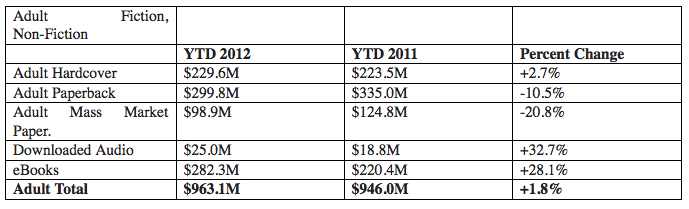 GalleyCat’s comments highlight the fact that ebook revenue ($282.3 million) has surpassed hardcover revenue ($229.6 million), but also gives paper its due by quoting the AAP report: “Trade Paperback remained a clear #1 in net sales revenue despite some erosion” (accessed 6/18/12). Yeah, I guess: $299.8 million is bigger than $282.3 million. Another way to look at it is that ebook revenue is less than 6% lower than trade paper revenue. Is that a “clear” lead? Well, it depends. In a U.S. presidential election, 6% is a blow-out. In a horse race, you’d better have a camera.
 The Active Voice